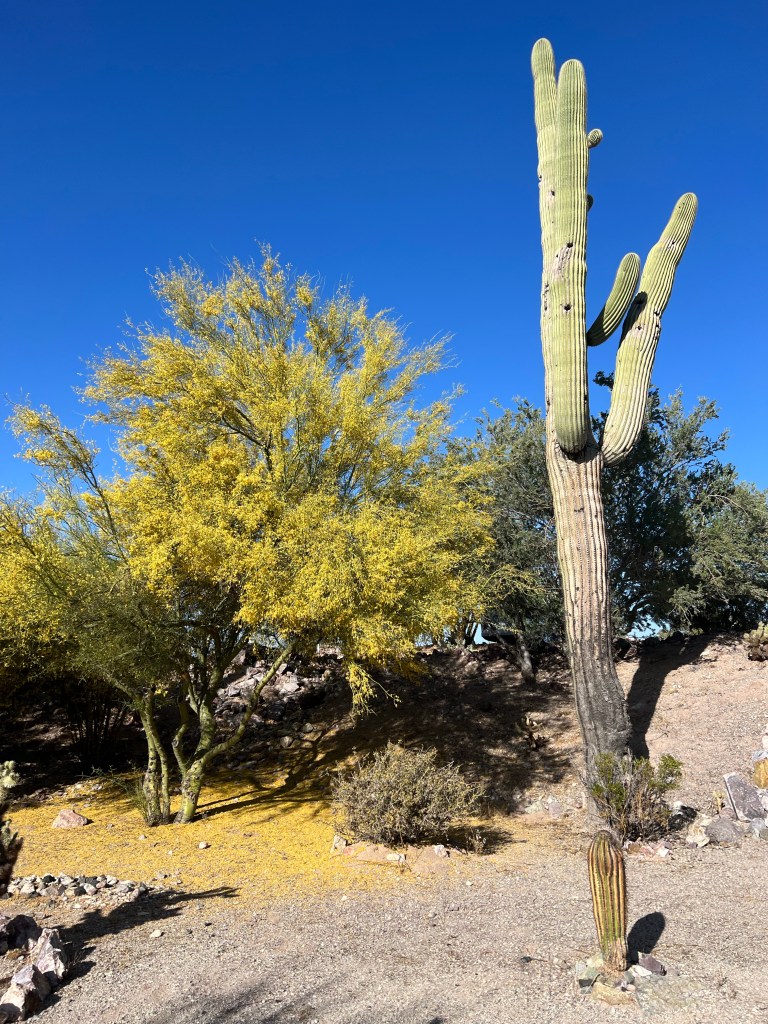
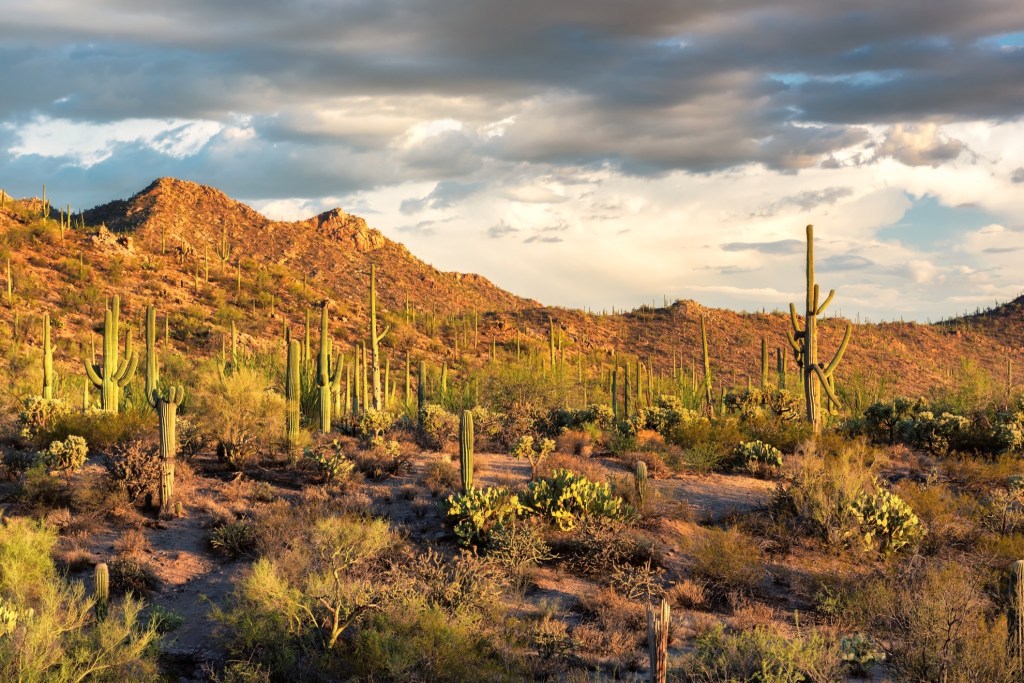
Today Gary and I met up in Ajo, AZ. we headed south through Saguaro National Monument. a beautiful drive through the Saguaro and Palo Verde forests. Both of which were in bloom. Large yellow/white flowers at the top of the towering monoliths with a lower canopy of yellow from the Palo Verdes. The desert is tríelo a wonder to see.
Palo Verde in bloom and giant Saguaro
The border town of Lukeville is at the southern edge of SNM. There’s not much to it other than a gas station, border patrol and The Wall. Crossing the US border is simple – just drove through. They don’t care who leaves. There are no stops, no checks, no cares.
Entering Mexico is also practically a non-event. While a visa (FMM) is required for all, it’s not checked unless it is. And if you don’t have one, well, that was dumb. the immigration process is easy.
The customs portion of the border crossing is confusing. Especially if you are bringing a vehicle in and not staying in Sonora or Baja. At which point, you have to purchase a TIP – a temporary import permit.l for your vehicle.
I got mine (for a motorhome) online and it was pretty straight forward. Gary couldn’t get his online and has to have the vehicle inspected. But there’s no where anywhere near that border crossing to do so. From what we gathered, we have to drive on until the inspection site before we get to Caborca – two days from now. Let’s hope they don’t make us go back to the border.
Sonoyta, the town on the southern side of the border, is a typical border town. They have speed traps, so they take you license and force a bribe – unless you want to drive to the police station with your truck and trailer on a Sunday. Welcome to Mexico. PS – they ignored the bus…
Puerto Peñasco
We arrived in Rocky Point or Puerto Peñasco around noon. Set up and walked to the Malecón where we were assaulted by all of the pharmacy and cash exchange vendors. Then by the restaurateurs. They all want the contents of our wallets.
One thing of note is that all of the ATMs in the malecón only dispense US$. And all of the vendors accept US$ at a terrible exchange rate. In these situations, I tend to purchase on my CC and have them charge me in pesos, my bank gives the daily rate with no markup and no fees.
We’re staying at an RV park near the beach. Which is basically an empty lot with a bunch of RVs in it. Not my thing, but they have power and that’s important if it’s hot outside.
Sea of Cortez – looking southwest
This trip is about adventures outside of the comfort zone…
Being flexible and ok with things that you’re not familiar with is ok. They aren’t bad, they just are. This trip is all about doing things differently and, well… let the adventures begin.
Little things we normally take for granted – like air conditioning!
Today from Palm Springs, CA to Ajo, AZ, it was a good 93° on the highway. It wasn’t a long day – a medium day. The heat wasn’t too bad inside. And there’s a story behind the aircon.
This bus came from Louisiana where it -had- a huge air conditioning unit. It was engine driven and was big and noisy. It also took up room inside, and room outside where I now have the holding tanks. So I ripped it out. I did put in an RV aircon unit, but they work off of 110v, not the engine. Meaning that it works while parked and plugged into shore power, not on the road.
The aircon only uses about 1200w of power and I had a 2000w inverter to power it – or so I thought. The brand I have is rated is VA and not watts. So that 2000 on the model – nope. More like 1600w. BUT… that’s the rating at 70°. Who needs aircon at 70°? As the ambient temperature goes up, the rating for the inverter goes down. So when the temps reach the 90’s or 100’s, the inverter won’t power the aircon.
So… I bought a larger inverter – a 3k. I had tried it off and on to make sure that it would work, but never -really- stressed it.
The other issue I had was that my batteries would only power the aircon for 2-3 hours. That wouldn’t work for long trips through the desert, so I connected it to the alternator on the engine. That worked for a while, until the engine computer complained of low voltage during high draw situation – I was drawing too much current from the old 135amp alternator.
So, a month ago, I replaced the alternator with a 200amp one.
So this combination of the aircon running off of my inverter powered by the batteries, solar, and the engine works great. It’s not -cold-, but it isn’t hot/uncomfortable either.
In mobile environments with limited resources, we learn how to conserve. I closed the dividing curtain and am just cooling the cab/kitchen area and not the back of the bus.
After five hours and 300 miles on the road in 90° temps outside, the inside is in the high 70’s to low 80’s.
Unrelated, I also put new tires on it a couple of months ago at $800 apiece I was hoping for a quieter, smoother ride – and I got it. It’s still a big truck chassis, and not a town car, but hey…
To combat the noise, I have a pair of noise cancelling earbuds. Things are good…
So where am I?
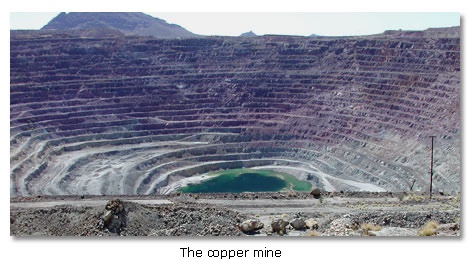
I’m in a little town just 40 miles north of the US-Mexican border called Ajo – Spanish for garlic. But they don’t grow garlic here. It’s possible it was named after the Tohono O’odaham word oʼoho meaning red paint or red tint. Ajo is rich in minerals and is home to the first copper mine in the state of Arizona. It’s interesting to see a satellite picture of it.
Ajo is also close to Saguaro National Park. And the saguaros are in bloom. Beautiful majestic cacti. a keystone species in the Sonoran desert.
Tomorrow my friend catches up to me and we will cross the border into Mexico. Puerto Peñasco is our first stop.
Well, after years of talking and months of planning, the journey has begun. I left yesterday and it was a long day. All interstate. All 520 miles of interstate. Ok – mostly interstate with some US highways thrown in.
Took the 101 to the 580, to the 5, to the 210. I was going to stay in San Bernardino but decided the extra 80 miles to Palm Springs to meet up with my friend was worth it. He’s staying at an established campground. When I got here, my frugalness led me to opt out of the $88/night KOA and park under the security trailer at the local Home Depot the price is good – free. No hassles. For transitory nights, I just can’t justify spending money like that.
I woke up before 0600 and my first urge was to hit the road. Wait – why? I have everything I need with me, my destination is only five hours away, I can leave at any time. So, I decided to sit back and enjoy my coffee in the cool morning desert air. Forecast today is 100° so better enjoy outside now than later.
The bus performed exceedingly well. Not towing the Jeep makes a big difference. I don’t have to monitor the temps, and I can travel with the flow of traffic. Not towing the Jeep, I’ve gained 150 miles range on one tank of fuel. Now I’m up to about 600 miles. heading over the grapevine, I stayed at 65 up and over. No struggle – it just went.
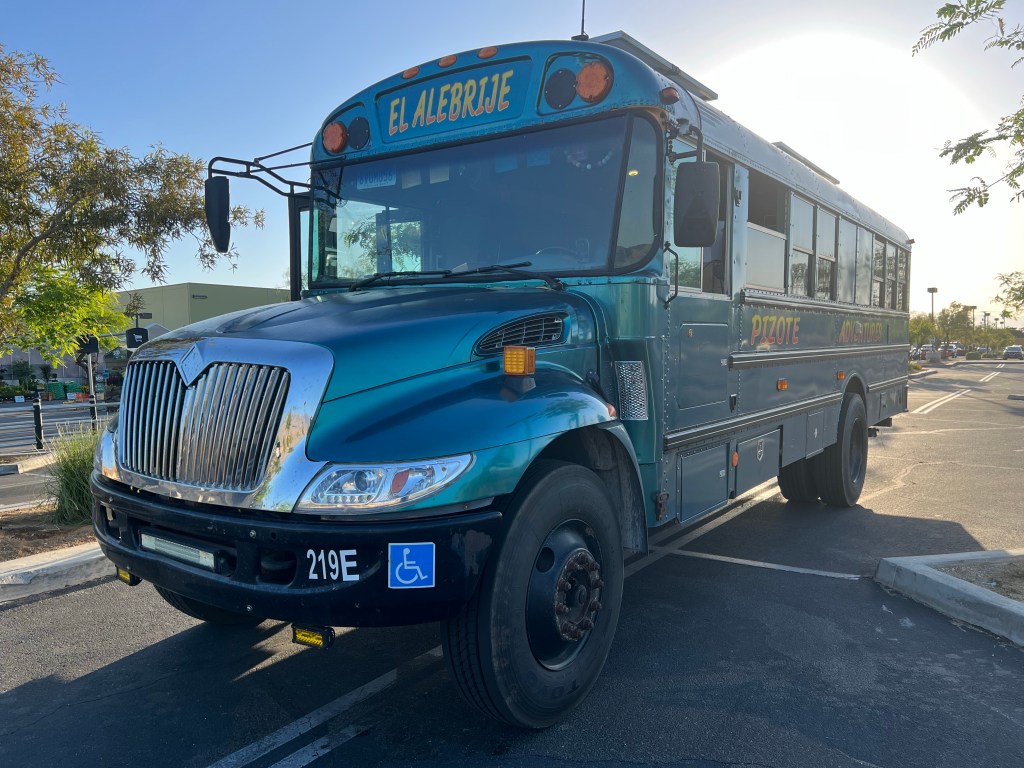
I’ve named the bus “El Alebrije”. Which is a fairly modern term in Mexico. It’s a piece of art. But more than that, it’s a fantastical creature with multiple aspects of spirit protectors or guides, or nahual. They are there to guide and protect you in every day life. Alebrijes are guided for the spirits. To guide them back to the world of the living, to the altar that those that remember them have built for Día de Los Muertos in November.
While my Alebrije is not guiding the dead, it is a fantastical merging of a school bus and a home on wheels, and it is guiding my inner Pizote, or mischievous self in this journey – where there is no destination, only the road traveled.
Wish me well on this journey and welcome along in the telling of it.
Alebrijes are brightly colored Mexican folk art sculptures of fantastical creatures. Originally, these creatures are created using a technique called papier-mâché, but are now carved in wood, and are often adorned with intricate patterns and designs. Alebrijes have become a beloved symbol of Mexican culture and are now popular all over the world.
History
The history of alebrijes dates back to the 1930s, when a Mexican artist named Pedro Linares fell seriously ill. While he was in bed, he dreamed or hallucinated of a strange place resembling a forest. There, he saw trees, animals, rocks, clouds, and other things that suddenly transformed into strange, fantastical creatures. In his dream, these creatures repeated a word to him: “alebrijes.” When Linares recovered from his illness, he started to create sculptures of these creatures, using papier-mâché as the main material. Over time, the craft of creating alebrijes transitioned into wood carving, and became a tradition in Mexico, passed down from generation to generation.
Meaning
The word “alebrijes” comes from two Nahuatl words, “alebrije” and “ixtle.” “Alebrije” means something that is not real or something that does not exist, while “ixtle” is a type of paper made from the bark of a tree. Together, the two words refer to the process of creating something that does not exist in reality.
Alebrijes are not only fanciful creations; they also carry important cultural and symbolic meanings. Many of these creatures are inspired by animals that are considered sacred in Mexican folklore, such as jaguars, eagles, and snakes. These animals represent different spiritual forces, such as courage, strength, and wisdom.
The intricate patterns and designs on alebrijes are also significant. These patterns are often inspired by pre-Hispanic art and motifs, which carry their own symbolic meanings. For example, the use of circles and spirals represents the cycle of life and death, while the use of triangles symbolizes the connection between heaven and earth.
Today, alebrijes continue to be an important part of Mexican culture. They are often created and sold by artisans in markets and shops throughout Mexico, but mainly in the state of Oaxaca. In recent years, alebrijes have also been featured in popular culture, such as in the movie “Coco,” which tells the story of a young boy who dreams of becoming a musician and encounters a magical world filled with alebrijes.
Alebrijes have become important facets in Mexican culture and have been interpreted, not only as protectors but also spirit guides where an Alebrije is paired with the spirit of a loved one and guides the loved one back to the altar during day of the dead festivals so that the spirits can see their family members.
Conclusion
Alebrijes are an important part of Mexican culture, representing a fusion of indigenous and Spanish influences. These whimsical creatures have captivated people’s imaginations all over the world, and their symbolic meanings continue to resonate with many. Through the craft of creating alebrijes, artists are able to express their creativity, preserve cultural traditions, and honor the natural world.
The time is rapidly approaching that I embark on another epic adventure with my good friend GLRay. This year, the adventure entails cultural exploration by visiting many Pueblos Mágicos and UNESCO sites in the central highlands of México. The general idea, as my brother-from-another-mother says, is to not have a plan. This year, we have a general idea of what we want to do, but it’s open ended and with a few exceptions, there is no itinerary. We will be traveling in a pattern guided by vagaries.
Our method of travel will be that of dérive. This word literally translates to “drift,” but thanks to some mid-20th century French philosophers, it can also refer to a spontaneous trip, completely free of plans, in which you let your surroundings guide you. This is a much different method of travel than either of us typically embark on, with lots of planning and strict itineraries. This is a journey of change, growth, awareness, and acceptance for what is.
We have some dates and timelines we must abide by, meeting up to leave, when to be at certain airports to pickup/drop-off family and friends that are visiting, visa limitations, etc. Other than the initial getting to México and our first couple of nights, we don’t know where this adventure will take us.
In my past adventures, I have been asked to write about them as most people don’t have the opportunities of travel that I have, and my stories are educational, funny, and inspirational – or so I’m told. I have found that the easiest way to reach people is on social media, but the little red flags and bells have me drooling worse than Pavlov’s dog, and I have better things to do with my time than watch cat videos and engage in toxic exchanges on social media. So the birth of this blog. If I can figure out a way to post my blogs posts of past adventures here, I will, but some of those are many years old and it might not be worth it.
The Dates
The current dérive plan – an oxymoron in itself is to enter México on May 14th, and to return sometime mid-late August, or maybe September… So as mid-May approaches, you will see more and more posts, and possibly a daily post once we enter México.
Meet the Players
El Alebrije – this is my beast. It’s a school bus conversion, it took me about 18 months to build. Another 24 months in fine tuning and changing things up to meet my needs. The latest iteration was to take out the two captain’s chairs and large dining room table, and in place install a sofa/lounge/bed and a smaller table (still sizable) for mobile work area/dining table, etc. For this trip, I will be taking just the bus. The Jeep (Pizote) stays home.
The word Alebrije is a new term in Mexican Spanish. For more information – visit El Alebrije
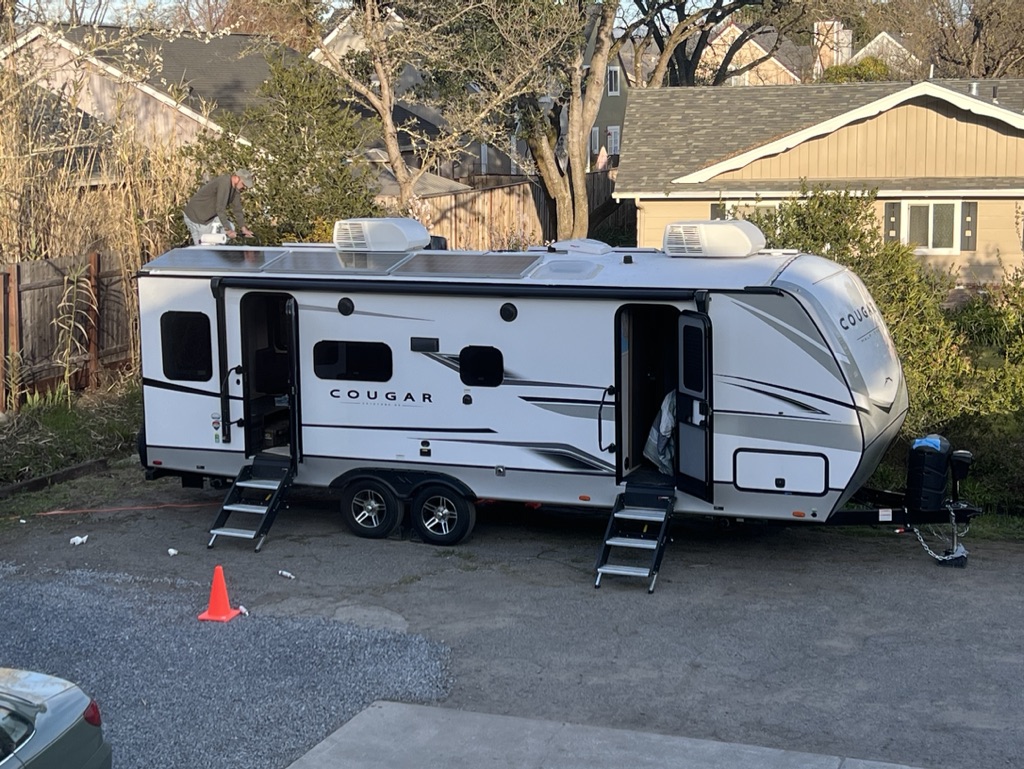
Owlbear – this combination is my friend GLRay’s rig. He bought the truck 18 months ago and the trailer about 8 months ago. We’ve been working on modifying the solar and electrical system of the trailer.
Unleashing the Power of Solar and Battery Systems: A Use Case for Electric Consumption in RVs
As the world moves towards sustainable living, more and more people are turning to renewable energy sources like solar power to meet their energy needs. This shift towards clean energy is also evident in the recreational vehicle (RV) industry, with RV owners increasingly exploring the use of solar and battery systems to power their adventures on the road. In this blog post, we will delve into the development of a use case for electric consumption, specifically for the specing of a solar and battery system in an RV.
Why Go Solar in an RV?
RVs are a popular choice for travelers who seek the freedom of the open road and the ability to explore new destinations at their own pace. However, traditional sources of power in RVs, such as generators or relying solely on the RV’s engine, come with their drawbacks. Generators can be noisy, require fuel, and emit harmful emissions, while running the engine for prolonged periods can lead to increased fuel consumption and wear and tear on the engine. This is where solar power can be a game-changer for RV owners.
Harnessing the sun’s energy through solar panels on the roof of an RV can provide a reliable and sustainable source of power. Additionally, coupling solar panels with battery storage allows for energy to be stored and used even when the sun is not shining, providing power during cloudy days or at night. This combination of solar and battery systems allows RV owners to enjoy the benefits of clean and quiet energy, while also reducing their environmental impact and saving on fuel costs.
Developing a Use Case for Electric Consumption
When it comes to specing a solar and battery system for an RV, it’s crucial to develop a comprehensive use case that takes into account the specific electric consumption requirements of your RV. Here are some steps to guide you through the process:
Assess Your Energy Needs: Start by evaluating your RV’s energy consumption requirements. Consider the appliances, devices, and systems that you will be using in your RV, such as lights, refrigerator, air conditioner, water pump, and entertainment systems. Note down their power ratings, usage patterns, and estimated daily energy consumption.
Determine Your Solar Panel Capacity: Once you have a clear understanding of your RV’s energy needs, you can calculate the solar panel capacity required to meet those needs. Consider factors such as the location and orientation of your RV during travel and camping, the average daily solar insolation in those locations, and the efficiency of the solar panels you plan to use. You can use online solar calculators or consult with solar experts to determine the optimal solar panel capacity for your RV.
Choose the Right Battery System: Selecting the right battery system is crucial for storing and utilizing the solar energy efficiently. Consider the capacity, type, and voltage of the batteries based on your energy requirements and the available space in your RV for installation. Lithium-ion batteries are a popular choice due to their high energy density, longer lifespan, and lighter weight compared to traditional lead-acid batteries.
Plan for System Integration: Once you have determined the optimal solar panel capacity and battery system for your RV, it’s essential to plan for their integration into your RV’s electrical system. Consult with a qualified electrician or solar installer to ensure the safe and efficient installation of the solar panels, charge controller, inverter, and battery system. Consider factors such as wiring, mounting, and protection against overcharging, over-discharging, and other electrical hazards.
Monitor and Optimize Your System: After your solar and battery system is installed, it’s crucial to monitor and optimize its performance regularly. Keep track of your RV’s energy consumption and the performance of your solar panels and battery system. Make adjustments as needed to optimize the system.
This Specific Use Case
It took us about four months to develop a use case that was workable. Some of the challenges were changing expectations of what is possible and normal, and personal behaviors of consumption, and maintenance. A simple difference between home vs RV life is that at home, people typically let the faucet run while brushing your teeth, where as in an RV with only 50 gallons of fresh water and perhaps days until you’re at a place where you can refill, the behavior is modified to just get the brush wet or use a glass of water for the whole process. The same goes for electricity. Turn things off while not using them, turn the heat down, turn the cooling up, etc.
In the end, it was decided upon the following:
Batteries should have enough capacity for three days without sun.
Air Conditioning could only be run for short periods of time on batteries to initially cool the area.
Install more efficient air-movers to help circulate warm and cool air.
Technology such as internet, monitors, etc. are required and thus their consumption 24×7 must be taken into account
Solar panels should recharge a minimum of 30% batteries in six hours of good sun.
The Inverter should be able to run everything in the trailer, not all at once, but at a minimum, all minor loads and one major load such as the air conditioner, microwave, or electric heater.
Components
Batteries
It was decided to go with a 24v system. There are advantages and disadvantages with this. The primary advantage is efficiency and lower current. Following Ohm’s law, V * I = P where V is volts (the amount of electricity), I = current or amperage (the flow of that electricity), and P for power in watts (the amount of work that the supplied electricity can do). So increasing the voltage from 12 to 24 volts, in turns reduces the current by half while still providing the same amount of power.
The number of batteries, it was decided, were six 100ah @ 12v Battle Born LiFEPO4 batteries. These are arguably at the top of the industry, much of the price of them is for the name. But they work, and that was very important to GLRay. These batteries (more tech talk) were to be configured in three parallel lines of two batteries in series – yeah, it’s a mouthful and the head needs to be wrapped around that. Basically it means that the two batteries in series will bump the voltage up to 24v. You put three of these series together in parallel and that changes to available amperage up to a whopping 300/600 amps. Not that this system would ever use that, but hey… it’s available. We actually limited it to 200amps, as there is nothing in the trailer that would ever exceed that – not even if all of the loads were turned on at the same time.
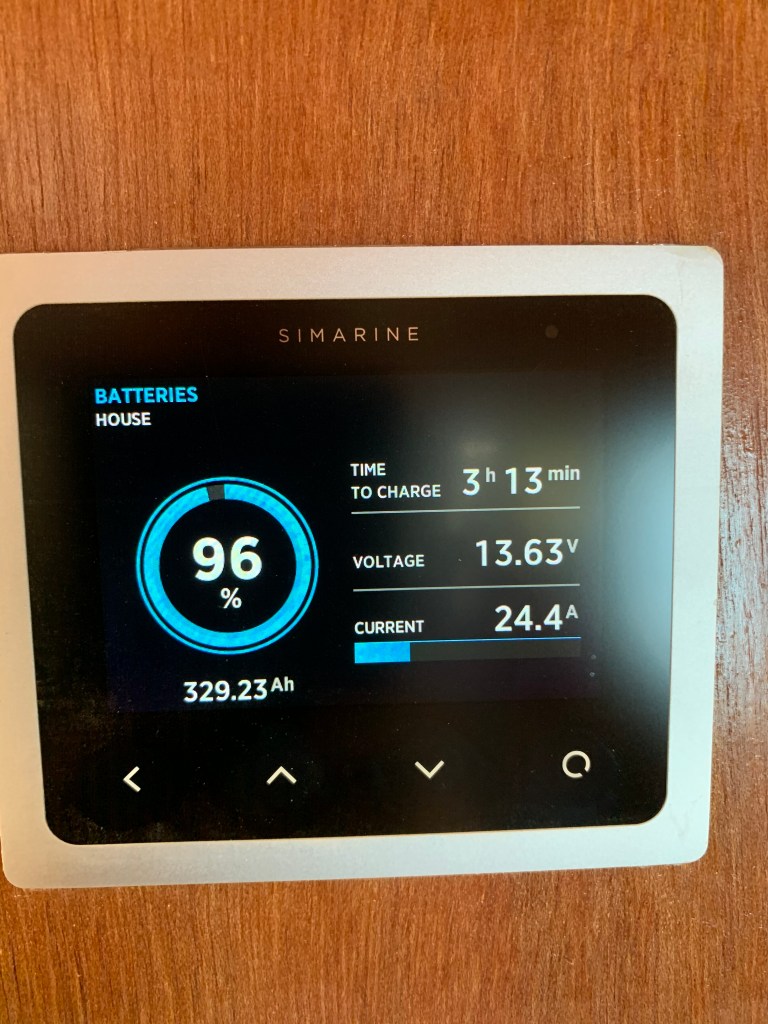
These batteries will provide 300ah @ 24v of power or 7.2kwh. That’s a lot of power, but not enough to run air conditioners all day long.
Solar Panels
As the use case stated, we needed the batteries to be charged a minimum of 30% in six good sun hours. That would call for a minimum of 450w of solar panels on the roof. That would be the bare minimums. There is also an arbitrary rule of thumb ration of ah@12v : 2x w for batteries:solar. So for this ratio, for the 300ah @ 24 or 600ah @ 12v, we would need 1200w on the roof. Since solar panels are inexpensive, we went this route. We have six 200w panels on the roof feeding the batteries and they generate quite a bit of power.
System Components
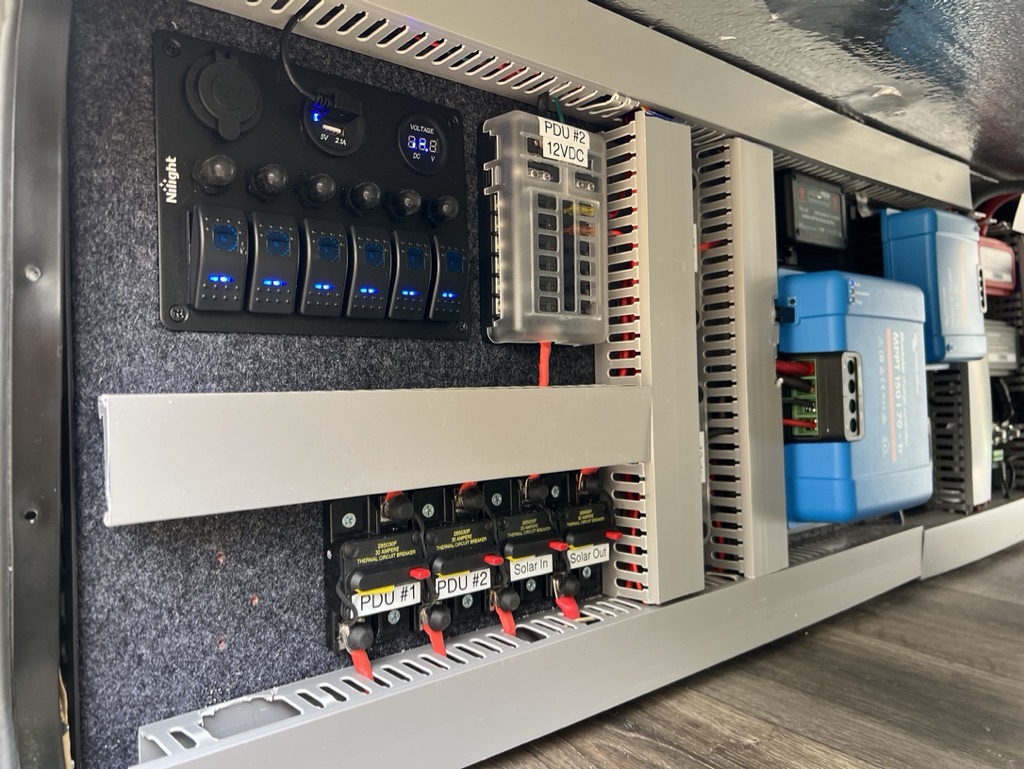
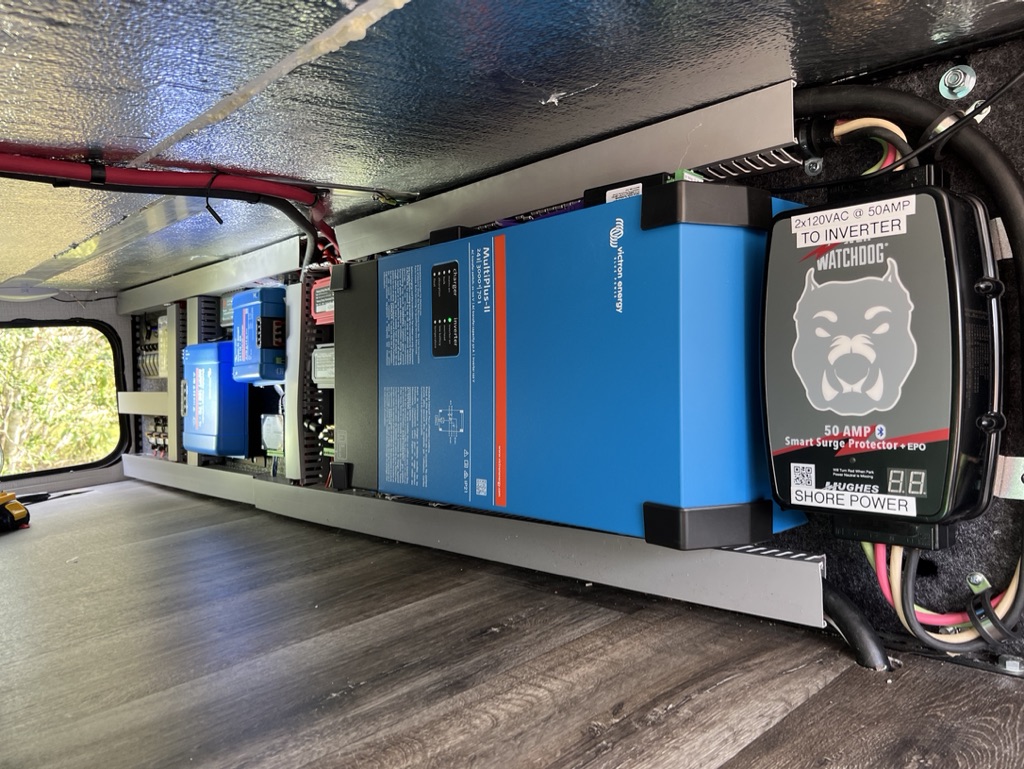
Since I have experience with Victron Energy components in El Alebrije, we decided to go with Victron all around – well… almost.
The SmartSolar MPPT controller is a 150/70. What this means is that on the input side, it can convert up to 150v, and on the output side, it can convert up to 70amps to charge the batteries. So min-maxed this SmartController could support up to 2000w of panels on the roof. We only put 1200w up there – so room to expend if we need to.
The next thing would be the Orion DC-DC charger. This device functions to take the 24v battery power and convert it to 12v for the trailer. All of the components in the trailer are 12v. This is a little bit of added complexity, but the trailer would always have the required voltage to run everything there – without having to worry about the voltage fluctuation of drawing directly from a 12v source.
Next is the brain of the system – the Victron MultiPlus-II 24/3000 2x120v. That’s a mouthful. This device is both an inverter and a charger. It will take shore or generator AC power and convert it to DC @ 24v to charge the batteries. It will also take the 24v DC power and invert it to 120v AC to power things like the air conditioners, the microwave, and laptop chargers.
System Monitor
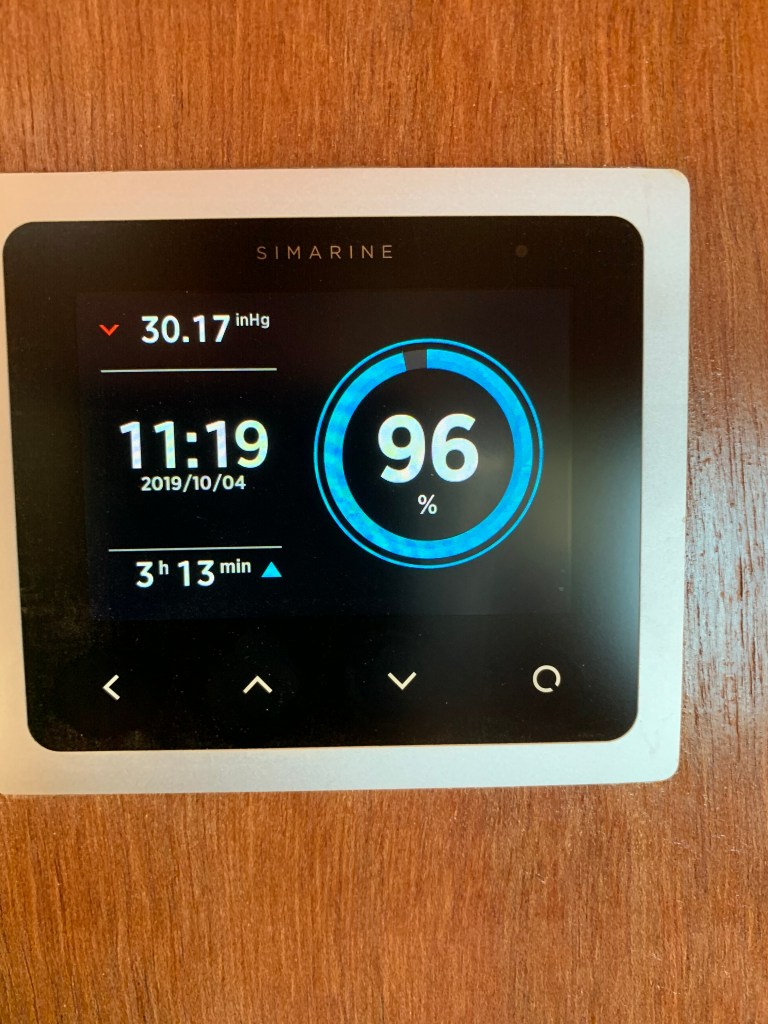
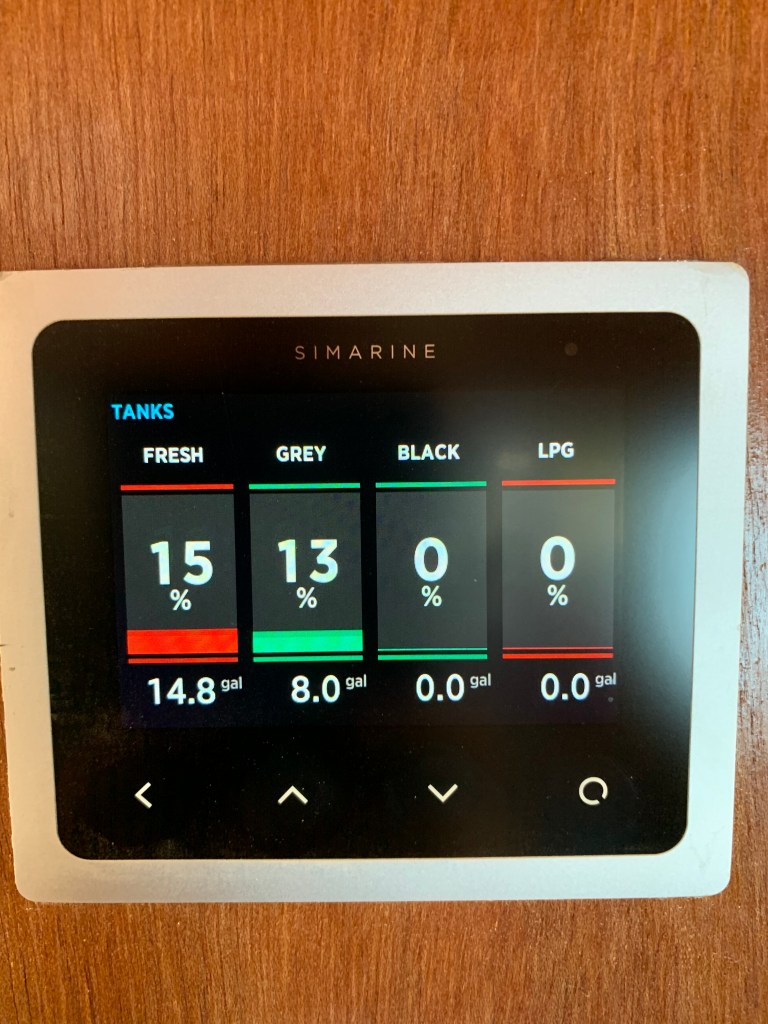
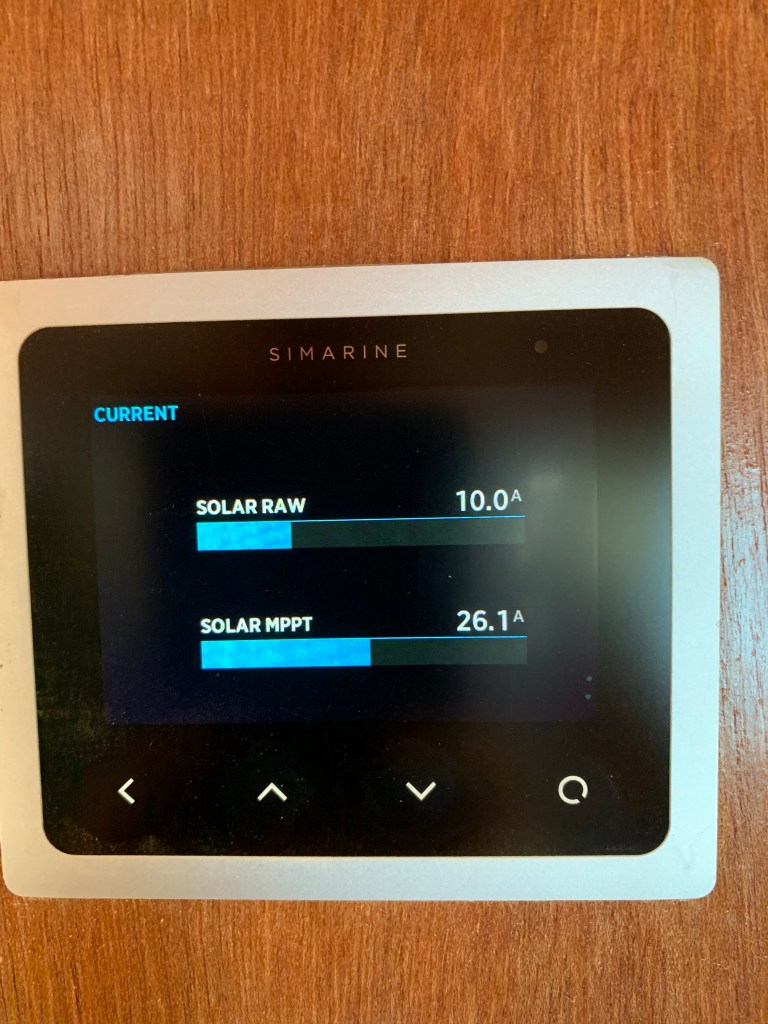
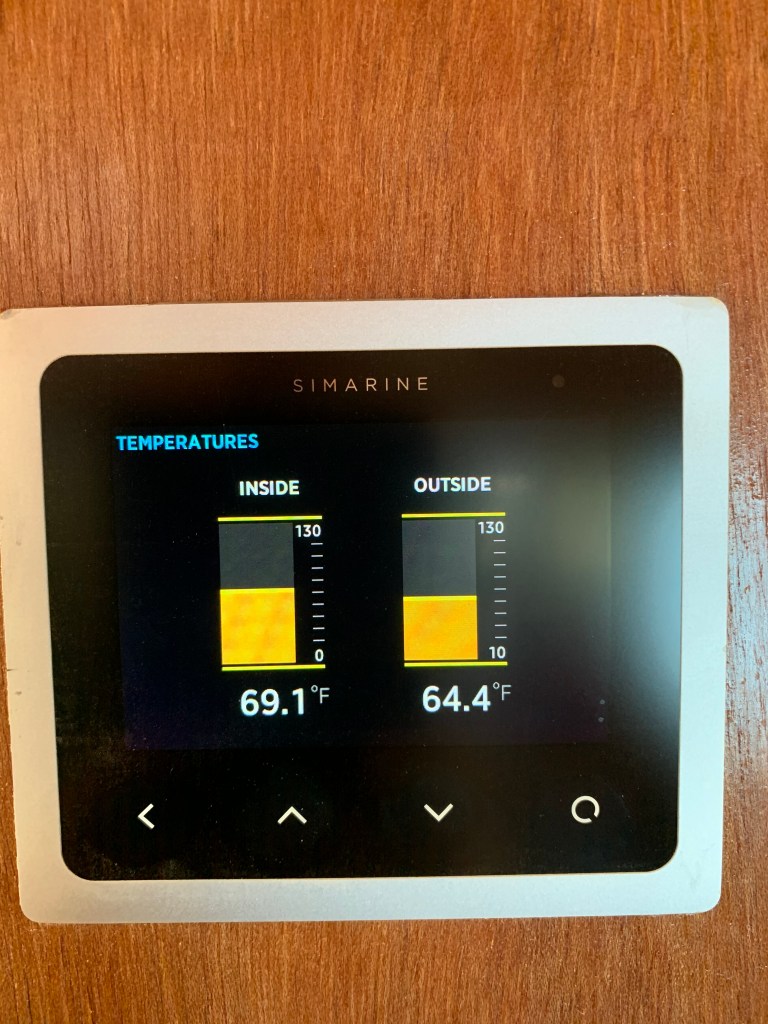
The system monitor is a display or UI that is installed in the trailer and relays pertinent information regarding the electrical system, holding tanks, and temperatures to the user. This is important for a variety of reasons, primarily to give information and knowledge. And as we all know, informed people and knowledge lead to power. With this information, we are able to adjust behaviors, change itineraries, etc. Without it, we would be surprised when we ran out of power or water – which would be a bad thing.
We chose to go with the Simarine Pico Blue. Made is Slovakia, they primarily focus on leisure water craft. It’s a pretty nice system, although there are some software issues – which, with time, are getting remedied.
Ironically, the main issue on the maiden voyage had to do with the Pico not reporting correct SOC (State of Charge) for the batteries, thus giving false information and a false sense of security – and a bit of frustration. That problem was fixed right away.
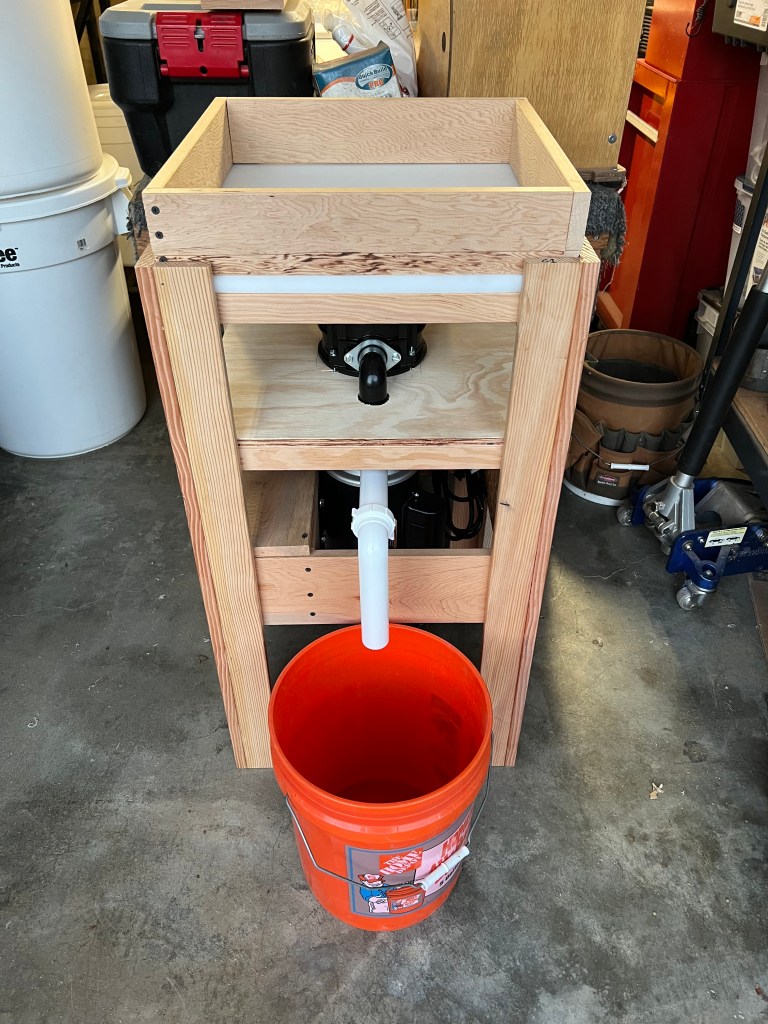
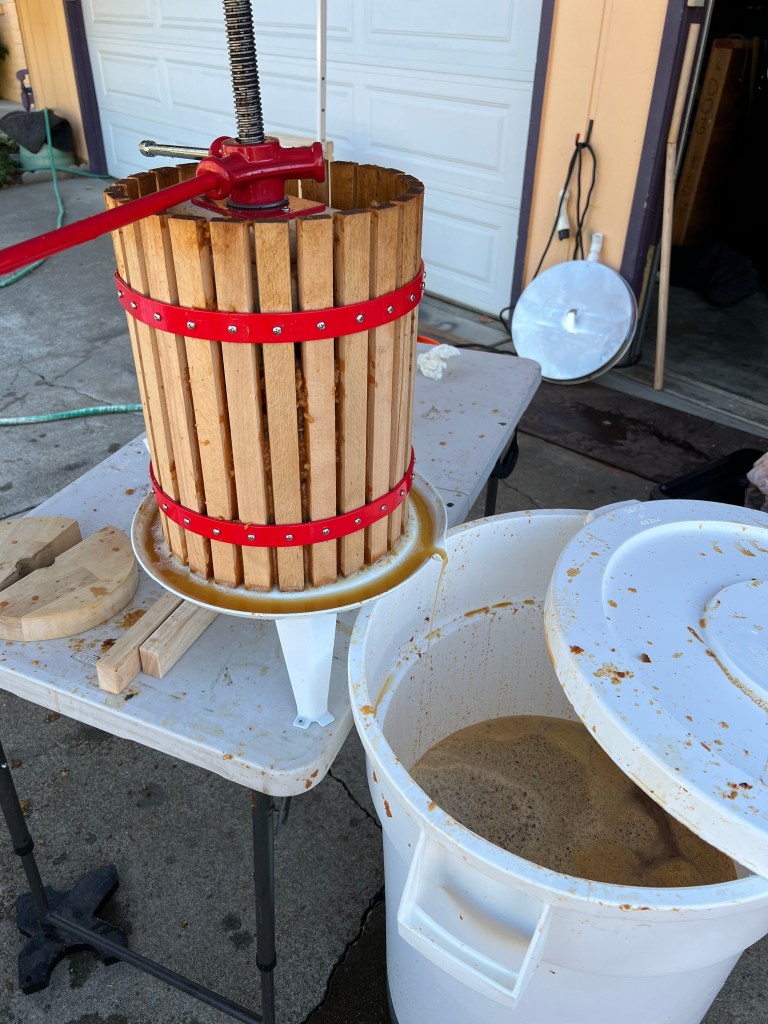
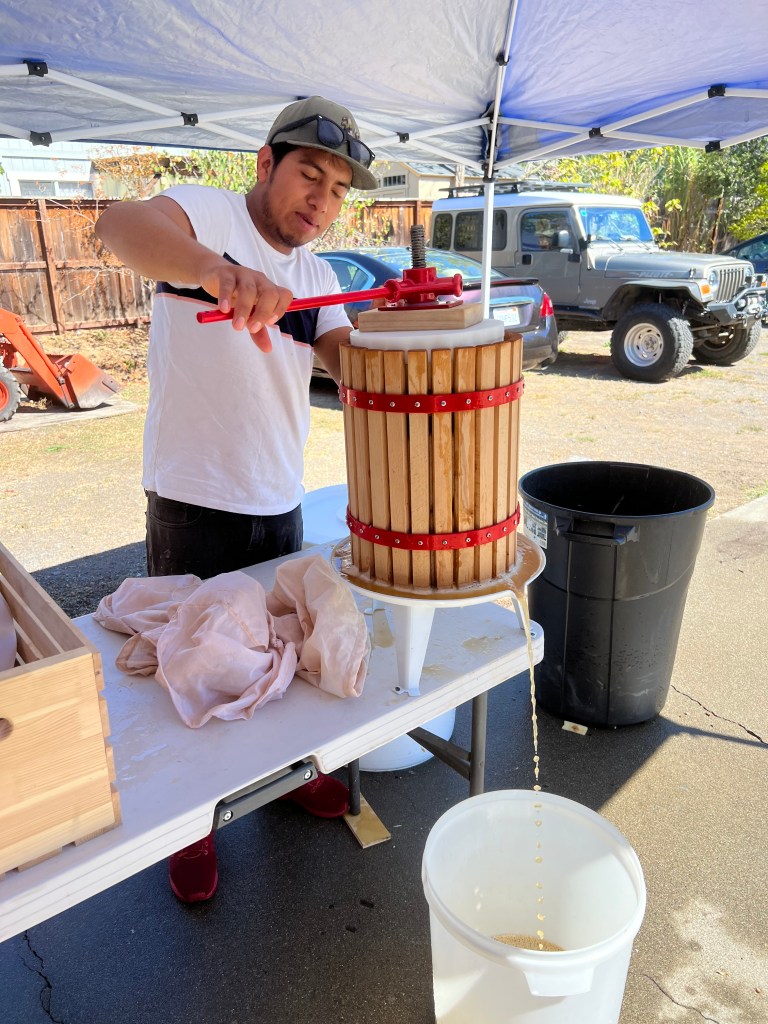
It’s that time of year again. 600lbs of apples sweating in the garage for a few weeks. Crush will be In a week or so. Then followed by pressing and a couple of bottles of sweat cider, and the rest to fermentation.
Last year my yield was low, I hope to double or triple it through a different crush process this year.
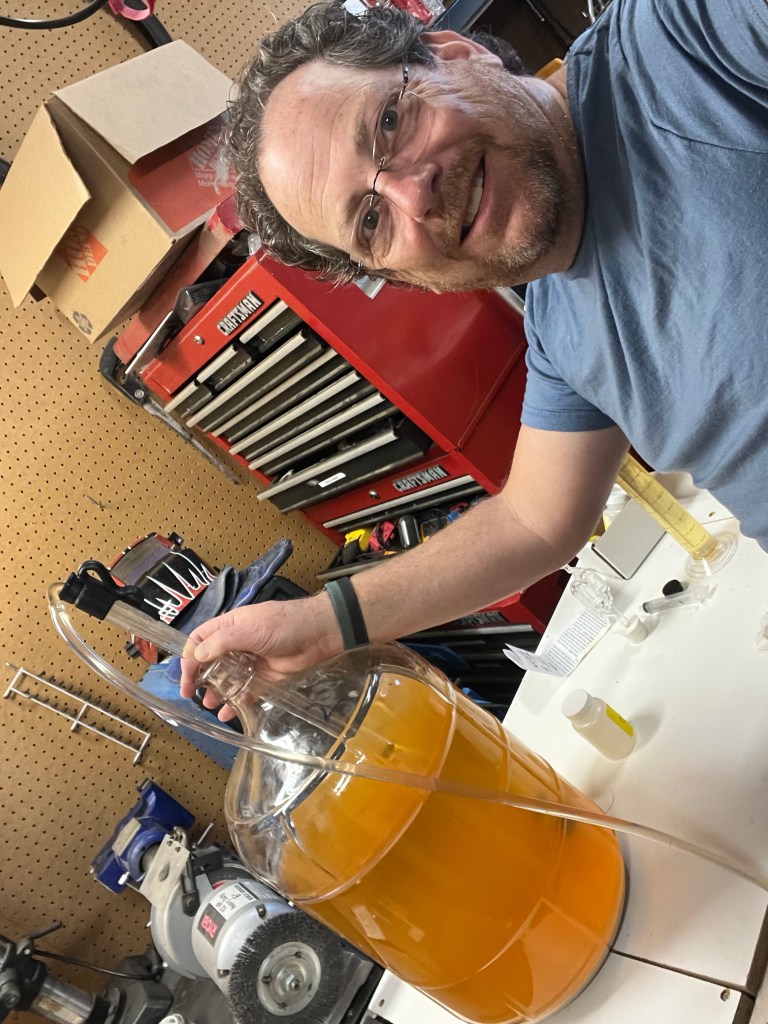
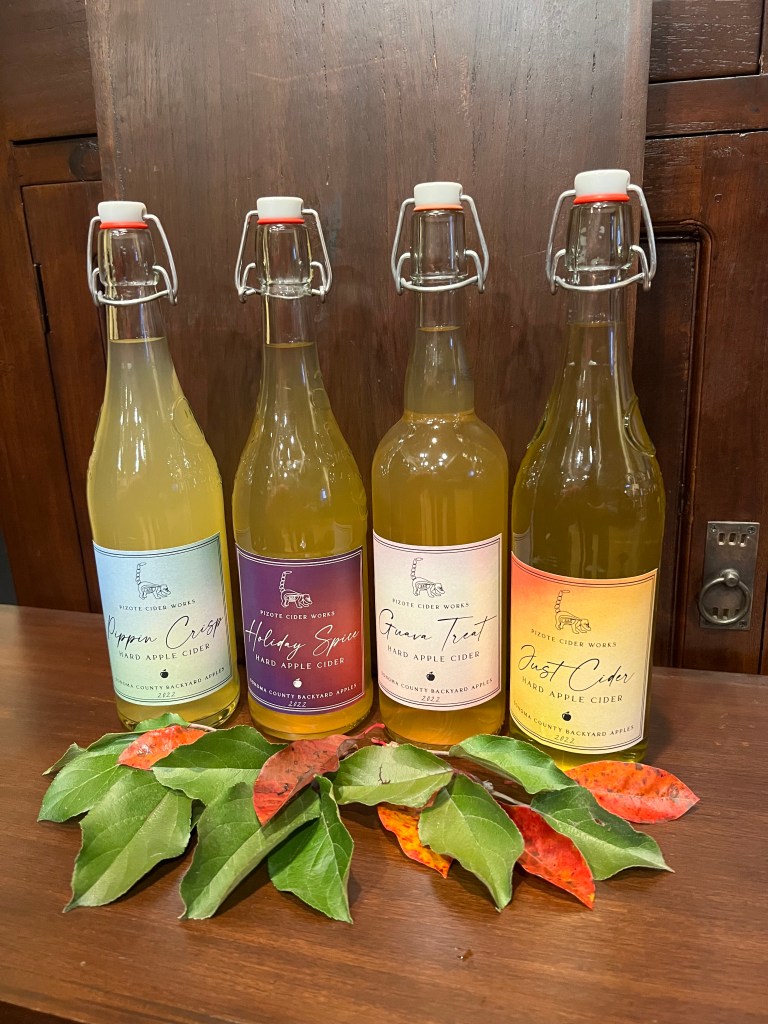
Since I made a new masher, I was able to double the yield from 2021. We got about 35gal of juice this year. Enough to make four different varieties and have a bit of simple cider left over to give away.
We had four varieties this year:
Pippin Crisp – a single varietal cider. Quite sour but is mellowing with time.
Just Cider – a multi varietal cider. Unfortunately this cider didn’t have enough sugar for the yeast and it became stressed and ended up being drinkable-but-funky
Guava Treat – a multi varietal cider back sweetened with guava nectar. Turned out quite nice with fruity hints of guava – not not to sweet.
Holiday Spice – the same multi-varietal cider back sweetened with holiday spices. This too was quite delicious and is getting better with time.
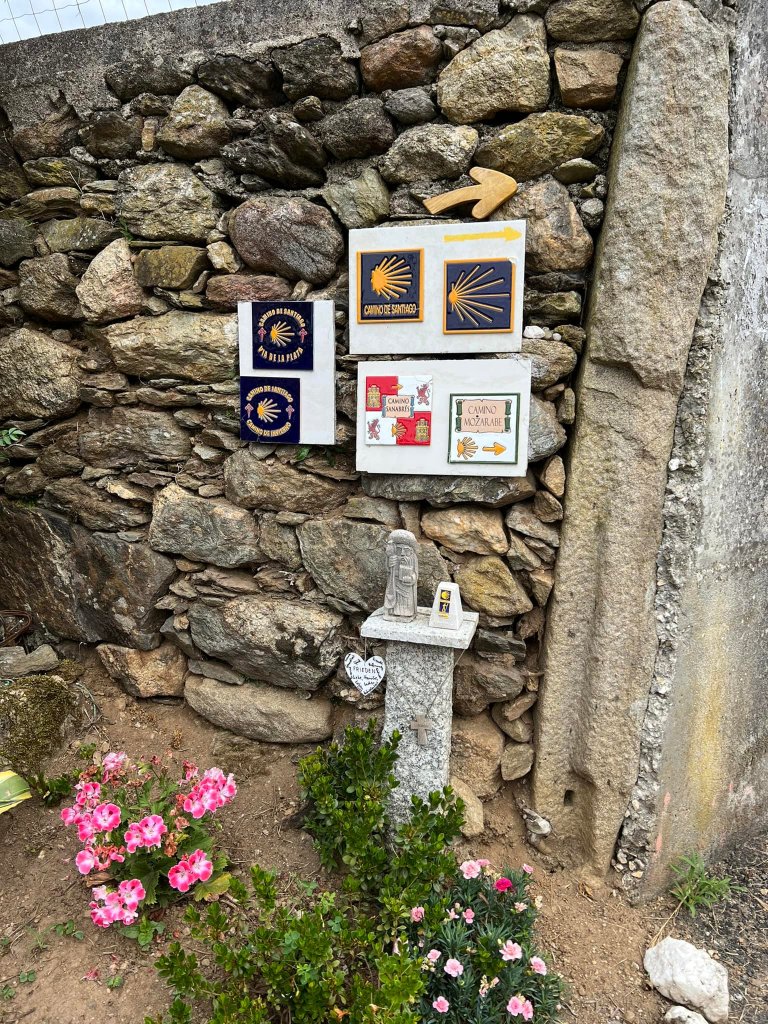
Today was the culmination of five years of wishing to go back to Spain and walk yet another Camino. This makes four arrivals in Santiago de Compostela and six different caminos.
The Camino Olvidado from Bilbao to Ponferrada is about 525km. That’s just trail walking. Daily walking to/from the bar can be up to 10km per day more, but is usually about 5km. The Camino de Invierno is 266km from Ponferrada to Santiago. That makes both routes a minimum of 791km. 791km in 30 days by foot is an accomplishment.
I was asked recently: why did people walk through the mountains for the Camino Olvidado? It’s simple really and has a lot to do with history and war. The Iberian peninsula was occupied by the Moors for many centuries (from 711ce through 1492ce). Because the remains of Saint James were discovered in the 8thC and reburied in the cathedral in Santiago in 847, during the Moore occupation, pilgrims to the tomb could not safely make their pilgrimage to Santiago de Compostela via the plains just south of the Cantabria mountain range. So the original routes were through the mountains – being the Camino Olvidado, Primitivo and Norte. During the winter, the Primitivo and the Olvidado were dangerous to travel due to the high mountains and bad weather – so the Camino de Invierno was taken during the winter, even though it posed dangers and risks by the Moors. There is much more history regarding the Moors, Santiago and the Caminos, and I recommend researching it online if you’re interested.
One tidbit of information: since the Arabs/Moors occupied Spain until 1492, there are many, many cultural influences in Spain from the Moors during this time. And of course, since Columbus sailed from the Iberian peninsula and the conquistadors brought over their culture to the Americas. Latin America has many, many Arab/Moor cultural traits. And since, much of the southern United States was owned/occupied/conquered by Spain/Mexico, we too have cultural, societal and language ancestral Arab/Moor roots. It’s a small world.
Back to the Camino…
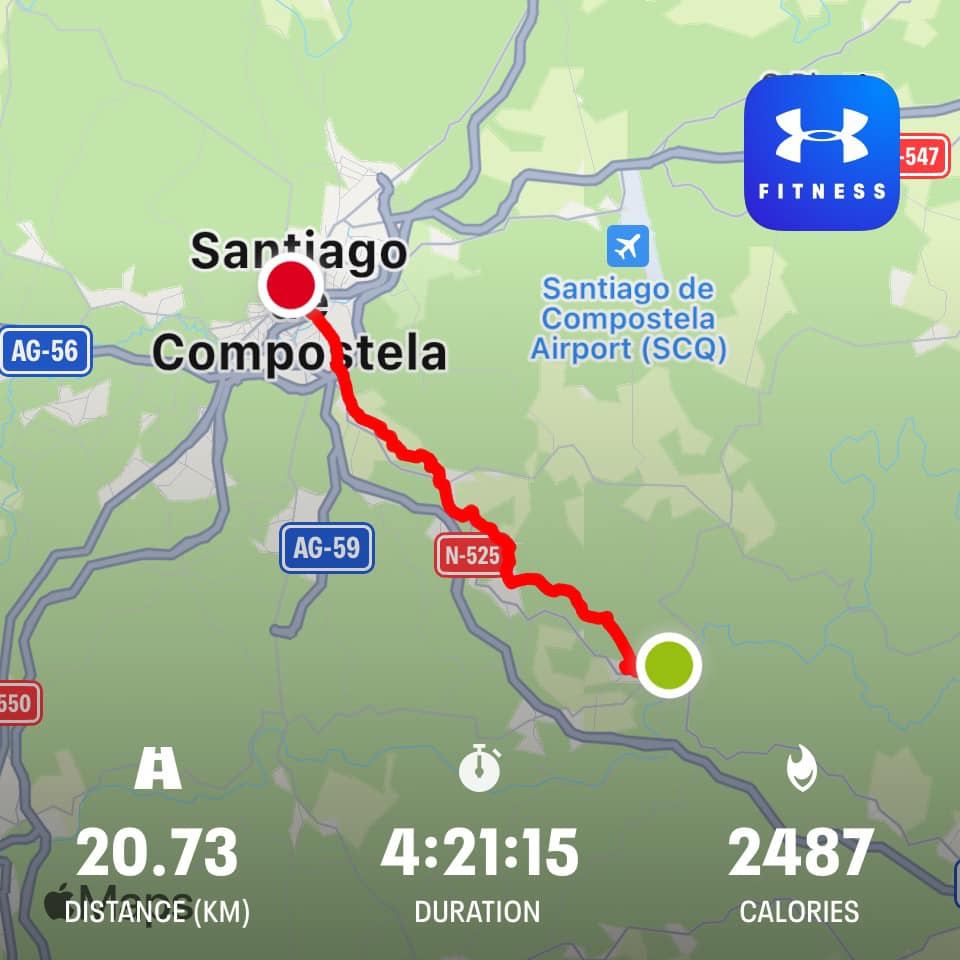
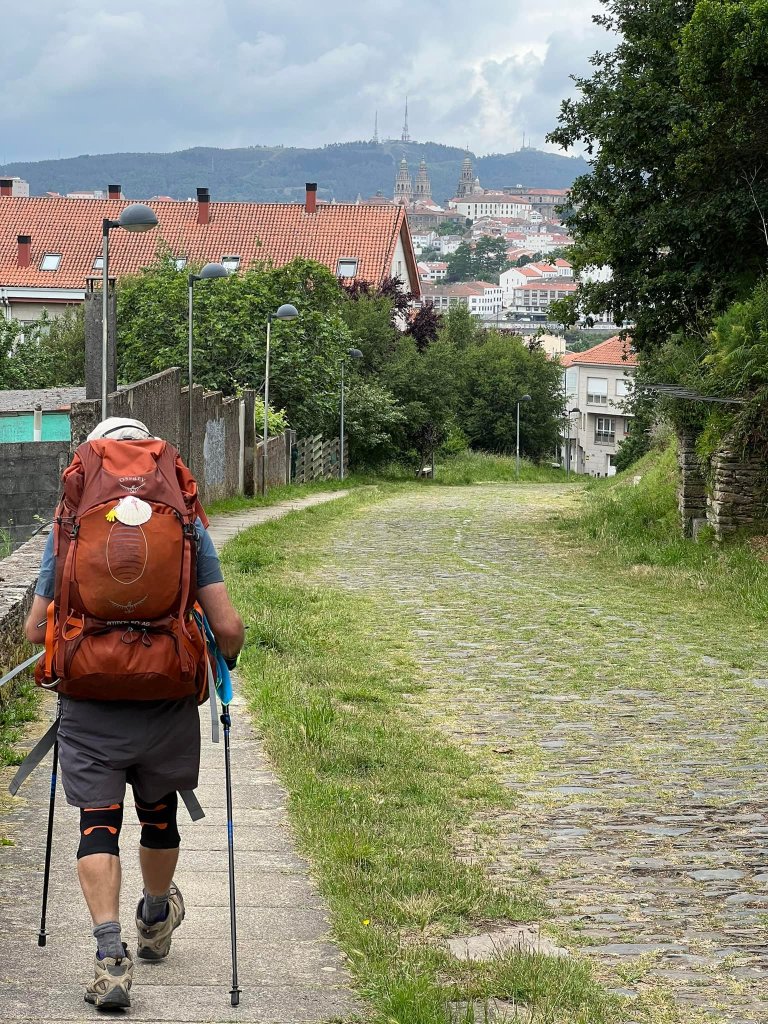
Today was short and sweet. 21km from Ponte Ulla to Santiago – and then another 2-3km wandering around and to the hotel. We’re at 25km for the day and will probably add a few more.
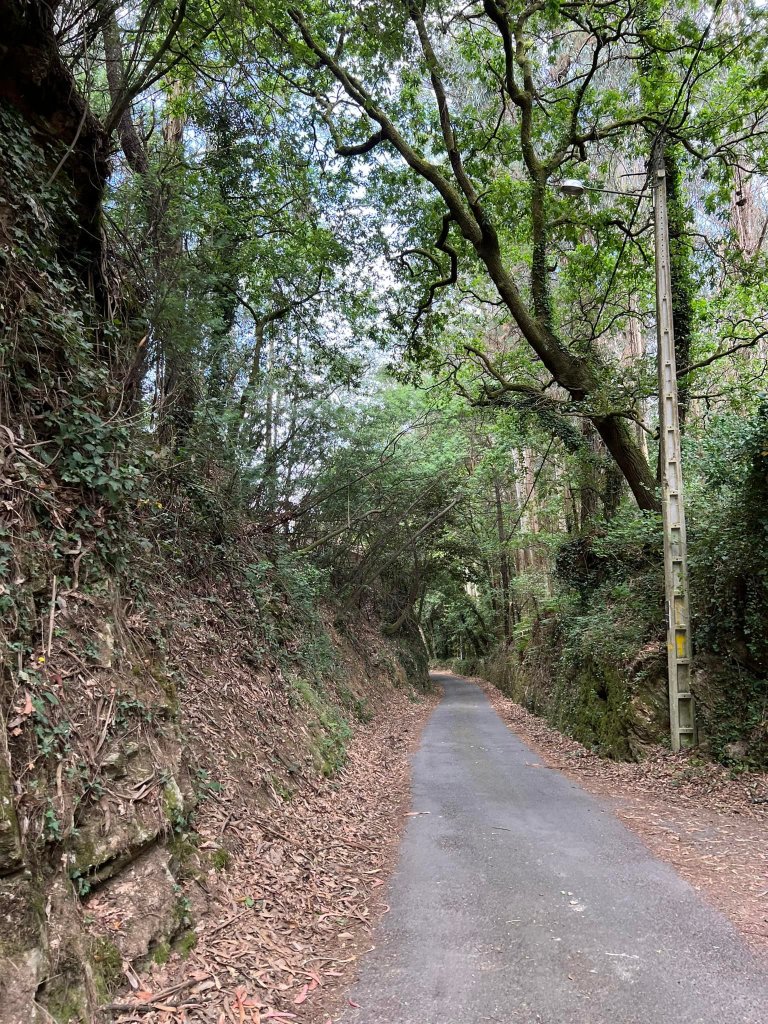
I have entered Santiago from the east and the southwest. Both are many km of suburbs and development. Not really enjoyable. Today I was prepared for something similar but alas, I was treated to 19km of farmlands, rolling country side and forests. Only the last 2-3km were in the city and part of that was through pedestrian walkways. So this was a really nice surprise.
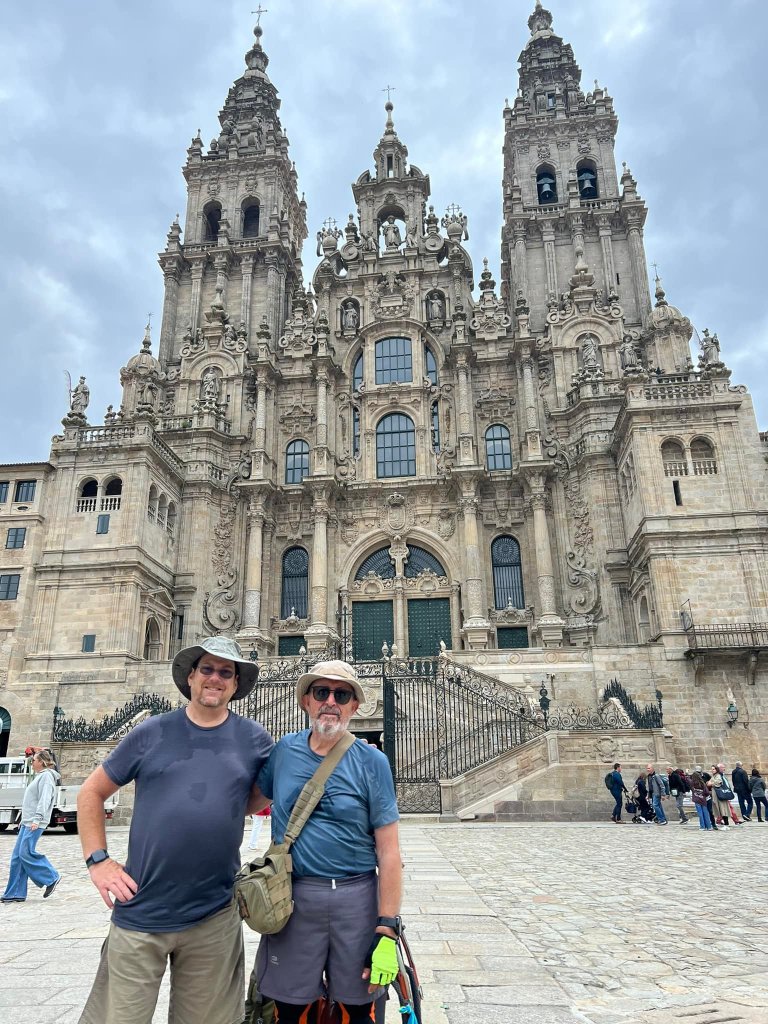
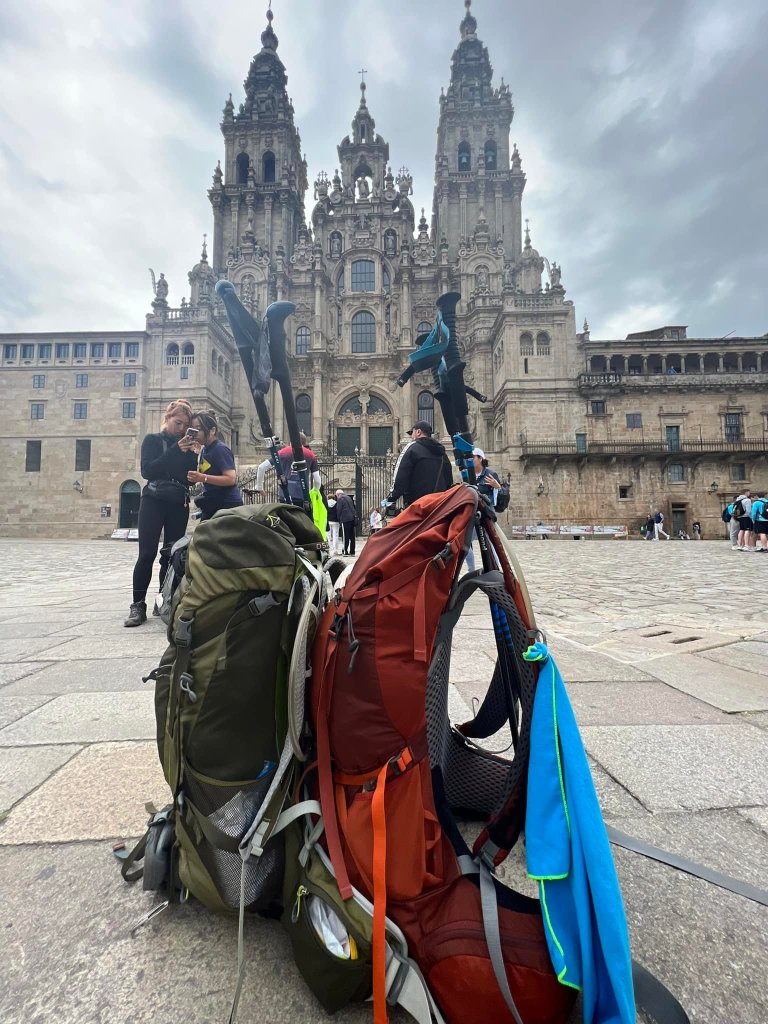
We got to the Cathedral around 12:30 – took some pictures and headed for the hotel. Tomorrow we will wander around and get our compotelas.
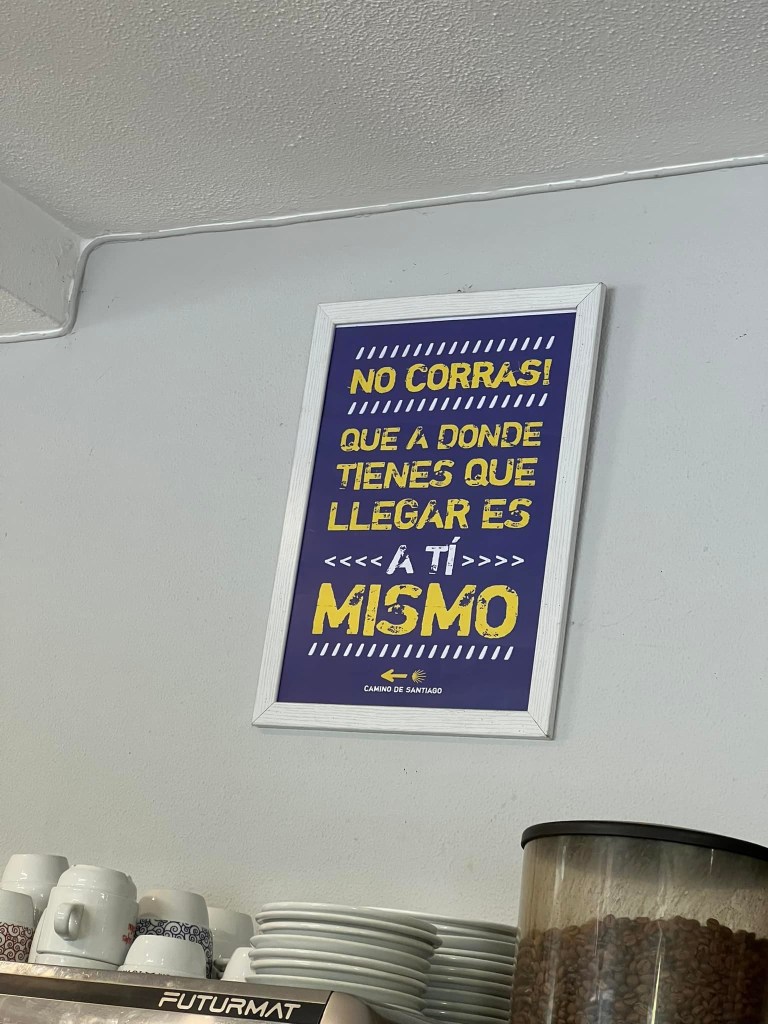
The walking portion of the camino is over. Now the real Camino begins. There is a saying: Your Camino starts when you reach Santiago. This has been true for the last three caminos. And I’m sure it will hold true for me this one too.
My current take away: there will be another Camino in my future. Perhaps on bike next time. I won’t know what it will be until I start on it.
Thanks for tuning in and for your comments. Buen Camino!!!
Yesterday and today were supposed to be 30km days. Tomorrow a storm is supposed to roll in with sprinkles in the afternoon and then dumping pretty good for the next three days. Due to weather and exhaustion, we decided to make yesterday and today 20km days and take a taxi between Lalín and Silleda. That would put us where we needed to be to get to Santiago before the storm.
I usually don’t post about injuries, but I had a double blister on one foot. One was infected. Last night it was difficult to walk. I went to the pharmacy and bought a syringe, cleaned out the infection and injected the blister with Betadine. This morning I woke up and the blister was all dried up and no pain whatsoever. I usually apply a protective layer to my feet to prevent blisters, today was the first day since May 2nd that I went with just socks. My feet are tired but no sore spots.
Today we went through Galician farm land. Rolling hills, fresh cut hay, wild flowers and… ever present smell of cows and their biproducts… today was especially aromatic – almost to the point of cow manure flavored chewing gum – all day long. It’s beautiful here…
Not a lot of photos but a nice walk. Tomorrow’s walk into Santiago is almost 100% asphalt suburbia – all 21km of it. It will be a slog, but it will be done.
Today was a good day. two days left on the Camino. We were supposed to walk 30km today to Laxe but decided to walk only 22km to Lalín. Seems like it was a good choice. There are lots of celebrations happening today.
Inclusive of my oldest graduating today with multiple degrees. Congratulations Miles – I love you and am proud of you.
Today’s walk was about half and half, dirt trails and country roads. It was probably one of the warmer days but not too bad – about 32°C. The walk was through rolling hills and countryside. There were several climbs but none that were difficult. The difficult part was a short climb and descent followed by another, and another, and another. Never long enough to warm up the climbing or descending muscles so they were always in conflict.
My feet are sore. The constant impact on hard surfaces is taking its toll on my heals. Descending is the worst since I place my heel down first. Ascending feels good. A down day is needed, but rain is in the forecast. So we will skip 20km tomorrow and walk 20km. That makes up for two 30km days in a row.
Two more days until Santiago. Bittersweet but happy.



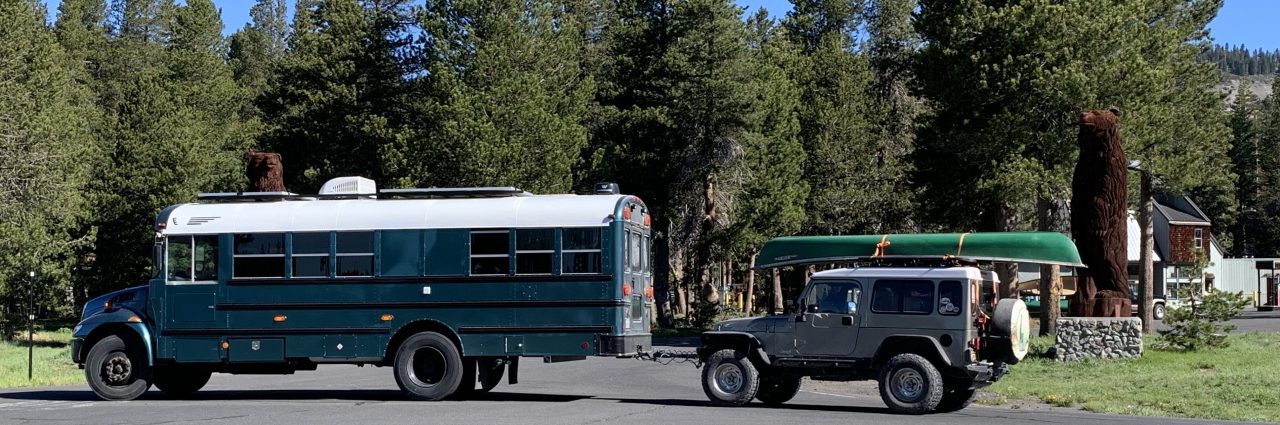 El Alebrije – this is my beast. It’s a school bus conversion, it took me about 18 months to build. Another 24 months in fine tuning and changing things up to meet my needs. The latest iteration was to take out the two captain’s chairs and large dining room table, and in place install a sofa/lounge/bed and a smaller table (still sizable) for mobile work area/dining table, etc. For this trip, I will be taking just the bus. The Jeep (Pizote) stays home.
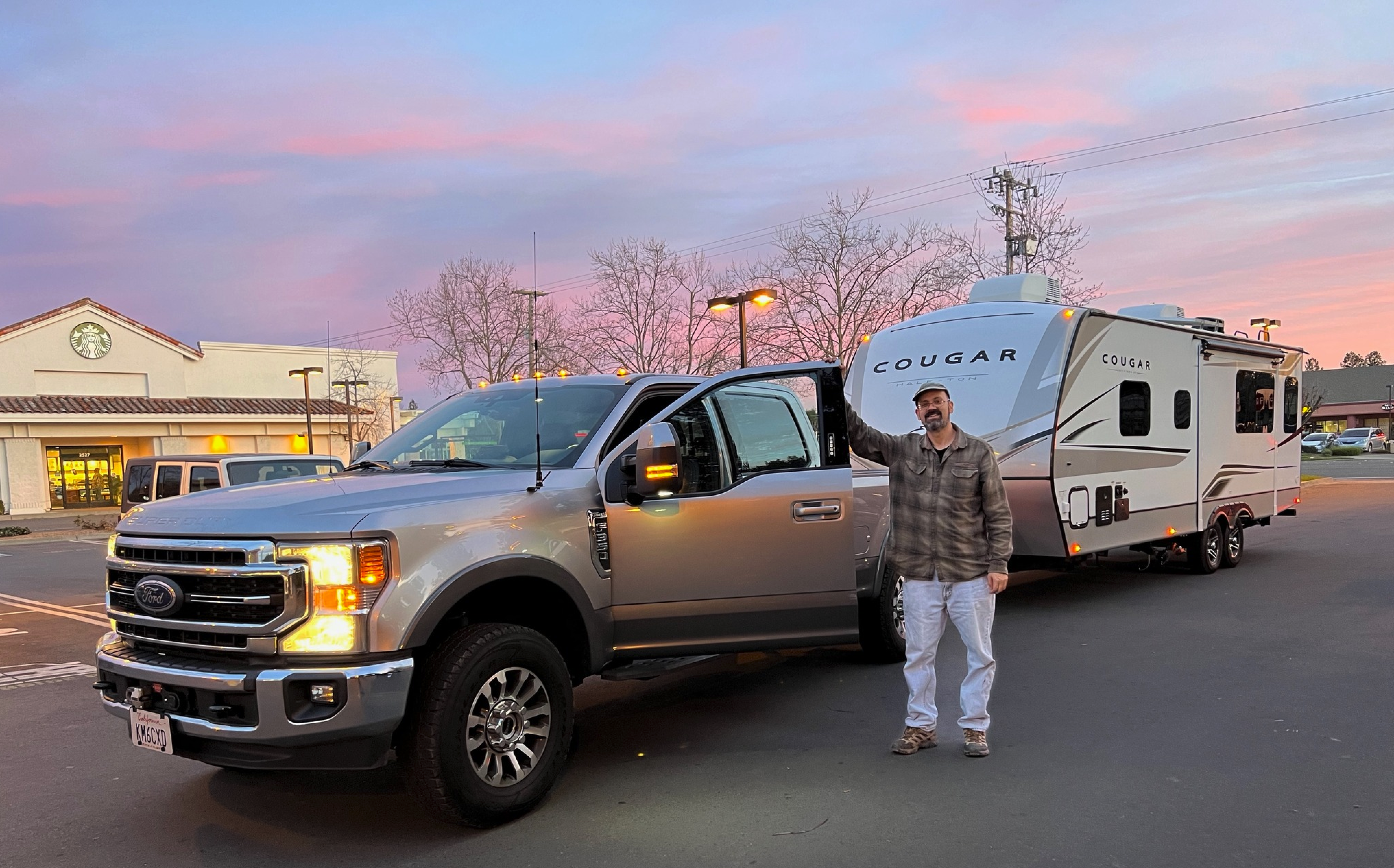 Owlbear – this combination is my friend GLRay’s rig. He bought the truck 18 months ago and the trailer about 8 months ago. We’ve been working on modifying the solar and electrical system of the trailer.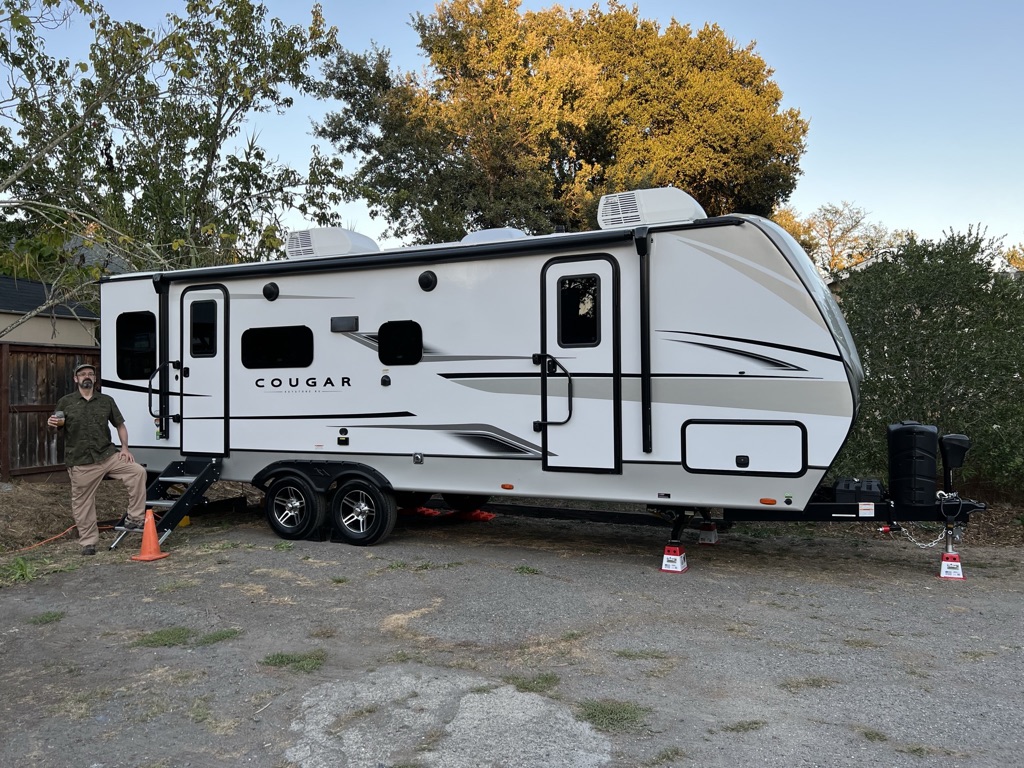










 Pizote Adventures