It started, as all misadventures do, with great optimism. I left my house near San Francisco at 10:00 a.m. Pacific Time, still fresh-faced and foolishly confident, bound for Bilbao via Madrid. The airline proudly announced our ride would be an Airbus A350-900, a plane so modern and enormous it likely required a PhD just to flush the toilets. They called it an “enhanced cabin experience.” What they meant was “you’re about to get to know your seatmates on a cellular level.”
This marvel of engineering featured a 3-3-3 seating arrangement, which meant I was wedged into the window seat like a letter in a too-small envelope. At first, I was optimistic. Window seats offer views, a headrest, and an illusion of control. But optimism evaporated the moment Garlic Guy sat down beside me.
He wasn’t actually named Garlic Guy, of course, but that’s what I called him in my mind. His breath was a pungent fog of undercooked garlic, possibly fermented, possibly weaponized. Every exhale burned. And when he wasn’t breathing at me, he was releasing slow, silent clouds of intestinal anguish that could have qualified as a biological event. The man was a mobile compost heap.
Add to this the seat pitch, clearly designed by someone who had never met an adult human, and my head firmly embedded in the seatback in front of me. I could feel the heartbeat of the guy reclining in front of me. And there was no hope of escape. Not unless I wanted to perform a full-body extraction that involved scaling the seatback like a disoriented pizote trying to leap from one tree branch to another. On my second attempt, I tripped over a headphone cord, elbowed the armrest, and landed halfway into the aisle with the grace of a sedated coati waking up all of the poor souls that managed to fall asleep for a brief moment.
We flew east into a four-hour night, which gave me just enough darkness to not sleep while dreaming about what it might feel like to stretch. After what felt like a week and a half, we landed in Madrid, and after a short hop north, I finally arrived in Bilbao.
As we descended into Bilbao, something unexpected happened. My forehead was still stuck to the window, half-asleep and dehydrated, when the clouds broke open to reveal the rolling emerald of the Basque countryside. It wasn’t just green, it was vibrant, like the whole region had been dipped in spring and wrung out over the hills. Forests blanketed the hillsides, meadows shimmered with wildflowers, and the city nestled into the landscape like it belonged there. It hit me hard, a gut-level certainty: this is a place I could call home. I hadn’t even touched down yet, and already I felt anchored.
Twenty-one hours after I had left, I checked into a hostel that offered me the lower bunk: a lovely wooden coffin with about 80 centimeters of headroom. The upper bunk had more space, but only three steps, one of them a lie, and I wasn’t about to test the limits of my remaining coordination.
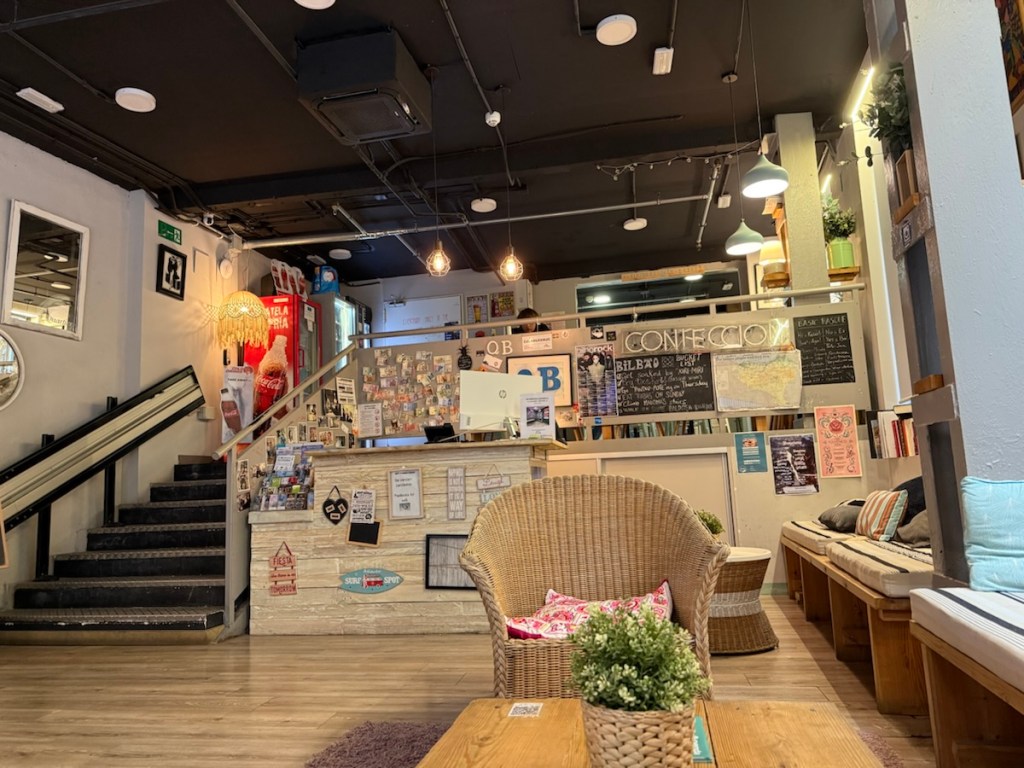
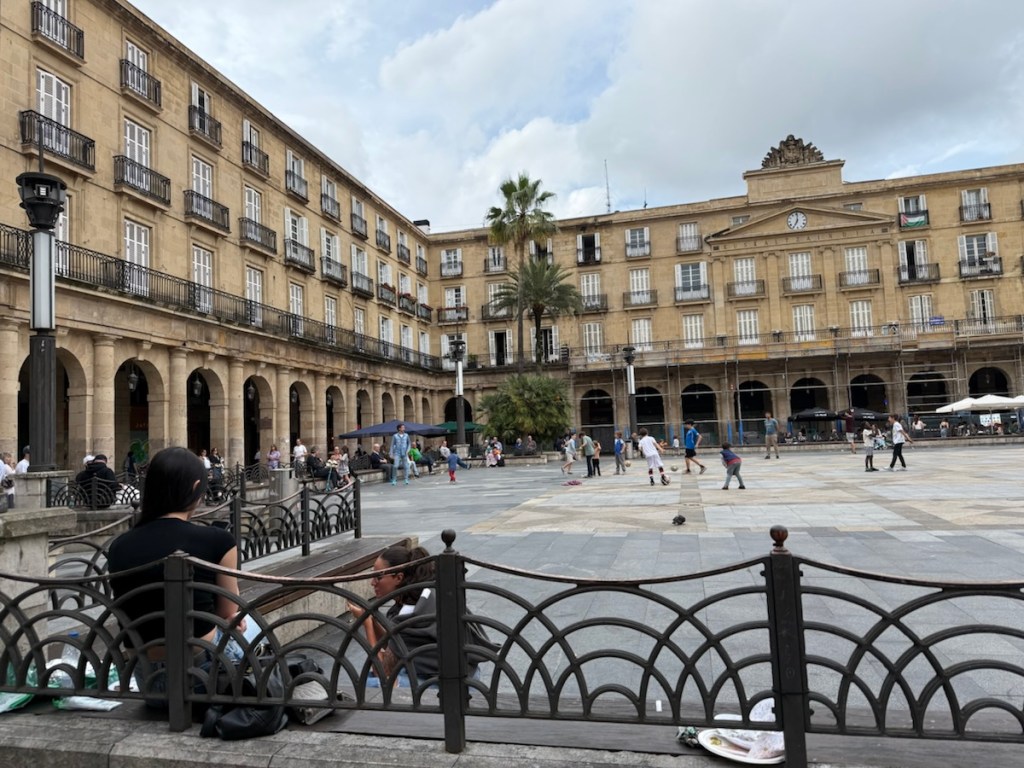
What I needed was food, air, and the quiet hum of other people’s conversations. I headed toward Plaza Nueva in the Casco Viejo, the kind of public square that feels like it’s been waiting for you to show up. Children ran free like pigeons, parents leaned into conversations, and the whole plaza pulsed with that timeless Spanish Sunday rhythm; the one where nobody is in a rush and somehow everything important still gets done.
I found a pintxo bar tucked into one corner of the square, a little jewel box of clinking glasses and laughter. There was a glass divider between me and the barkeep, and despite my best efforts to speak clearly, we ended up in a classic game of charades. I pointed. He nodded. I pointed again. He handed me something else. I was so hungry it didn’t matter what it was; ham, cod, some kind of marinated mystery on bread. It was all good.
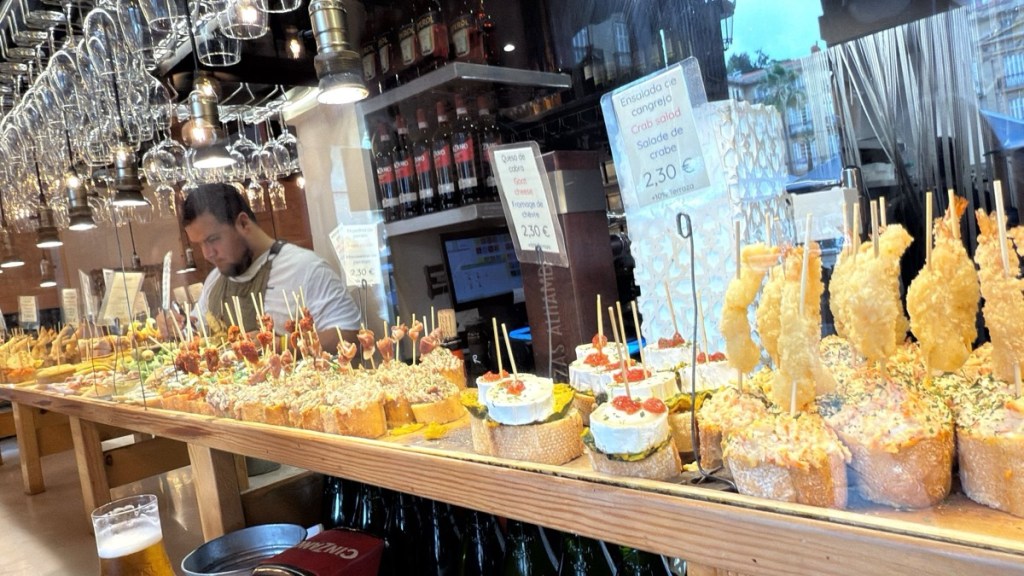
I stood there at the counter, slowly chewing, watching life unfold around me. The plaza, the people, the late afternoon sun sneaking in through the archways. No one was hurrying. No one was yelling. It was like the world had turned down the volume just for a moment so I could hear myself breathe again.
I was still tired. My nostrils were still singed. But I was there, in Spain, in my favorite kind of place, surrounded by strangers who didn’t care who I was, just happy to share the moment. And for the first time all day, I didn’t feel like I was trying to get anywhere. I was already there.

 Pizote Adventures